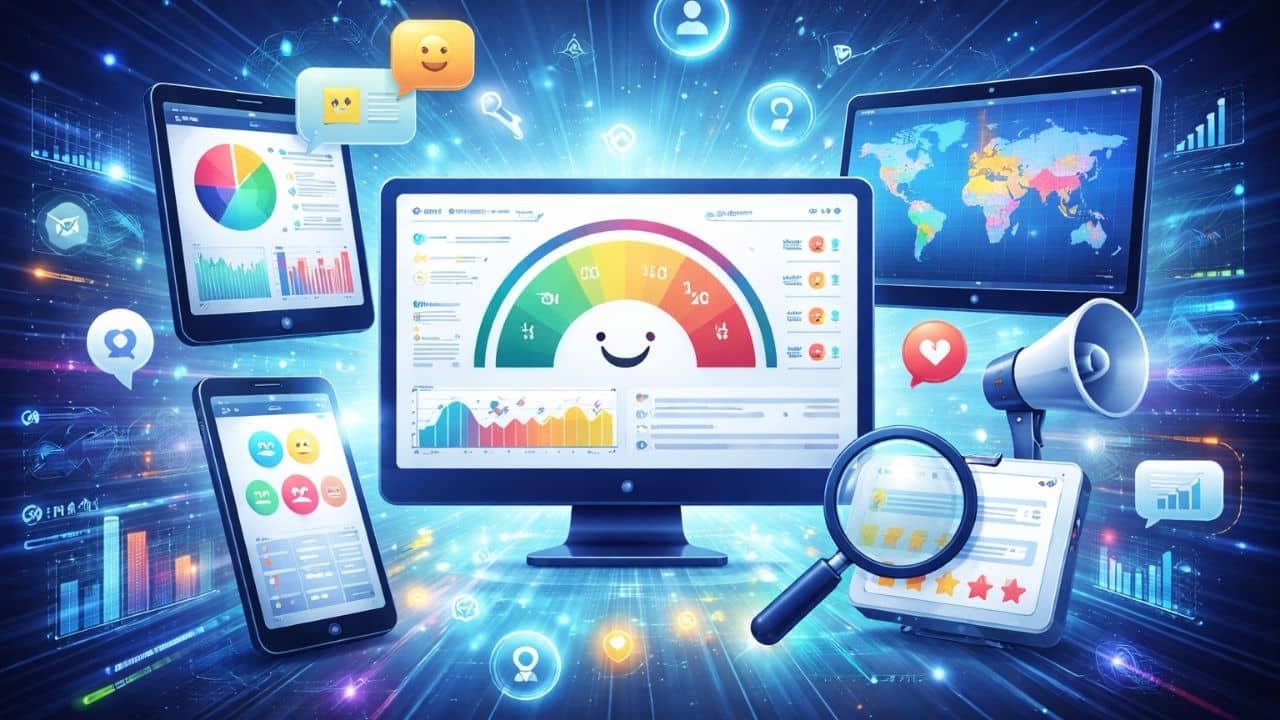
Brand sentiment shows how people feel when they talk about a brand online.
These feelings appear in reviews, social posts, forums, and support messages.
By tracking sentiment, we can understand trust, anger, or excitement in real time.
Good tools help us see patterns that are hard to catch by hand.
Clear insight supports better decisions across marketing, product, and support teams.
1. Social Listening vs. Basic Monitoring
Social listening goes deeper than counting brand mentions.
It studies the words, tone, and meaning behind what people say.
Basic monitoring only tells us how often a name appears and where.
That approach misses emotion, intent, and context.
Listening tools help us understand why people speak and what they expect next.
2. AI-Driven Sentiment Classification
AI-driven tools scan thousands of posts and comments in minutes.
They classify text as positive, negative, or neutral using language models.
This speed helps teams react while topics are still active.
Accuracy improves when tools are trained on industry terms and brand language.
Regular reviews help catch errors and improve confidence in results.
3. Real-Time Crisis Alert Systems
Crisis alerts watch for sudden jumps in negative sentiment.
These jumps often signal a service issue, bad news, or viral complaint.
Alerts reach teams through email, chat, or dashboards.
Fast notice allows calm and planned responses.
Clear response plans work best when alerts arrive early.
4. Competitive Sentiment Benchmarking
Benchmarking compares our sentiment with key competitors.
This shows whether problems are unique or common in the market.
Tools track the share of voice along with emotion.
A drop in our score may matter less if all brands fall at the same time.
This view helps leaders set fair goals and priorities.
5. Organic Brand Advocate Identification
Some customers speak well about a brand without rewards.
Tools find them by tracking repeated praise and strong tone.
These voices often influence others through trust and honesty.
Reaching out with thanks builds loyalty.
Long-term relationships matter more than short campaigns.
6. Sentiment-Based Product Feedback Loops
Sentiment tied to product feedback shows real user experience.
Tools connect emotions to features, updates, or bugs.
Teams can see if a change improved mood or caused frustration.
This data supports better planning and testing.
Products improve faster when feedback stays visible.
7. Sarcasm and Contextual Nuance Detection
Sarcasm can turn praise into criticism with a few words.
Simple tools often misread these signals.
Advanced systems look at context, emojis, and past language.
This reduces false positive or negative scores.
Better reading leads to better responses.
8. CRM and Support Ticket Integration
Sentiment data gains value when linked to CRM systems.
Support teams see customer mood alongside past cases.
This helps agents choose the right tone and speed.
Patterns across tickets reveal deeper issues.
Integration turns data into daily action.
9. Geographic and Demographic Sentiment Mapping
Mapping sentiment by location shows regional differences.
A campaign may succeed in one area and fail in another.
Demographic views reveal how age or interests affect tone.
These insights guide targeted messages.
Local awareness helps avoid broad mistakes.
10. Multi-Metric Brand Health Dashboards
Dashboards combine sentiment with volume, reach, and trends.
Leaders see changes without digging through reports.
Clear charts support quick understanding.
Daily tracking keeps teams aligned.
A shared view supports better teamwork.
Conclusion
Strong sentiment tools help us listen with purpose.
They turn online noise into useful signals.
Each tool adds a different layer of understanding.
When combined, they guide smarter choices.