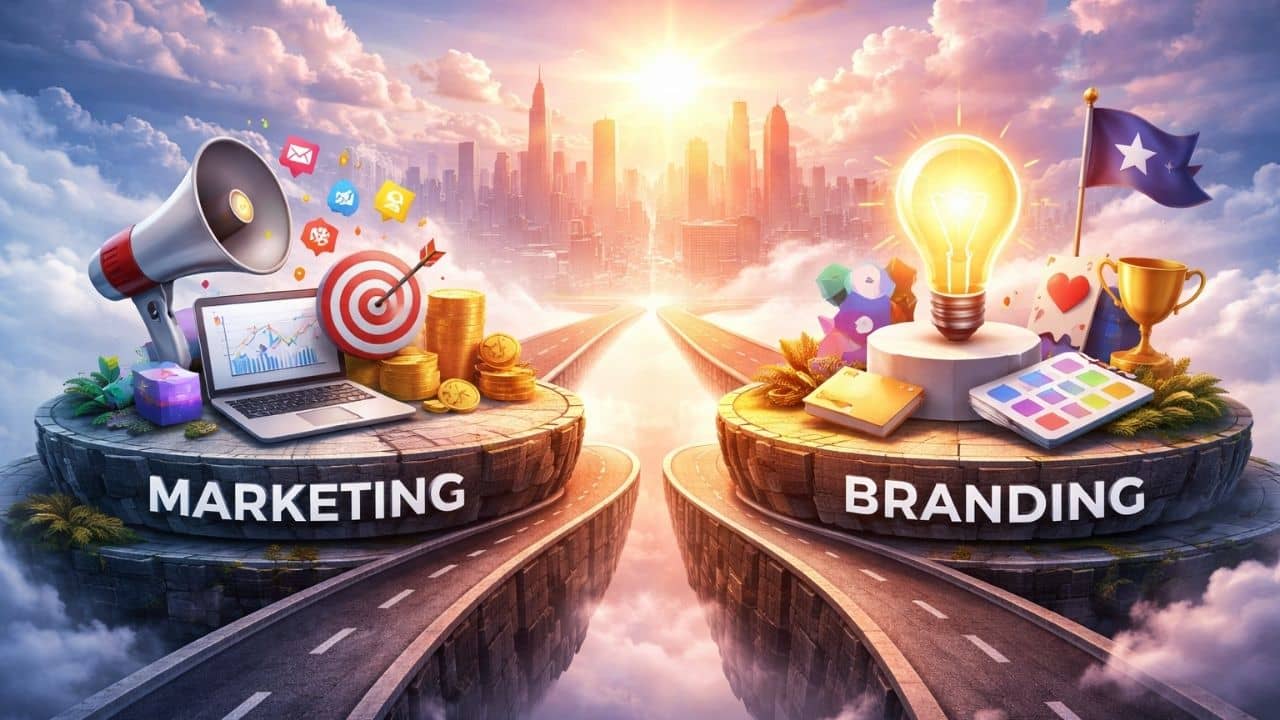
Many startups confuse marketing and branding because both aim to grow the business.
Clear thinking helps us decide where to spend time and money first.
Marketing focuses on actions that create demand.
Branding shapes meaning and trust around the company.
When we understand both roles, decisions become easier and more focused.
1. The Tactical “Push” vs. Emotional “Pull”
Marketing uses a tactical push to place messages in front of people.
Ads, emails, and search results all work to drive attention fast.
Branding creates an emotional pull that makes people want to come back.
Feelings like trust, excitement, or safety guide that pull.
Startups need both pressure and attraction to grow in a balanced way.
2. Short-Term Conversion vs. Long-Term Reputation
Marketing works to turn interest into sales as quickly as possible.
Metrics such as clicks, sign-ups, and purchases guide these efforts.
Branding establishes a reputation that develops gradually over time.
Reputation affects word of mouth, reviews, and referrals.
A startup that ignores reputation may win sales but lose trust.
3. Product Features vs. Core Purpose
Marketing explains product features and how they solve a problem.
These details help customers compare options and decide faster.
Branding communicates the core purpose behind the business.
Purpose explains what the company stands for and why it exists.
When the purpose is clear, the features feel more meaningful.
4. Company Outreach vs. Customer Perception
Marketing controls outreach through planned messages and channels.
The team decides what to say and where to say it.
Branding lives in the mind of the customer.
Perception forms through experiences, service, and consistency.
Strong branding aligns outreach with how people actually feel.
5. Fluid Campaigns vs. Static Identity
Marketing campaigns change often to match goals or seasons.
New offers, messages, and channels appear as data changes.
Branding stays steady to build recognition and trust.
Logos, tone, and values remain consistent over time.
This steady identity helps campaigns perform better.
6. First-Time Sale vs. Lifetime Loyalty
Marketing focuses on winning the first sale.
Promotions and offers reduce hesitation and speed up decisions.
Branding focuses on keeping customers for the long term.
Loyalty grows through trust and shared values.
Long-term customers support stable growth and lower costs.
7. The Direct Call-to-Action vs. The Visual Story
Marketing uses clear calls to action like buy now or sign up.
These messages guide people toward the next step.
Branding tells a visual story through design and tone.
Colors, fonts, and style shape how the company feels.
A strong story makes actions feel natural instead of forced.
8. External Promotion vs. Internal Culture
Marketing speaks to people outside the company.
Ads and content shape how the market sees the product.
Branding also shapes internal culture and behavior.
Values guide how teams work and make decisions.
A healthy culture supports honest and clear promotion.
9. Competitive Pricing vs. Perceived Value
Marketing often competes through price and deals.
Discounts help attract attention in crowded markets.
Branding increases perceived value beyond price alone.
Strong value allows higher prices without losing trust.
Customers then focus on quality and fit.
10. The Promotional Engine vs. The Strategic Foundation
Marketing acts as a promotional engine that drives traffic and leads.
It needs fuel, like budget and data, to run well.
Branding serves as the strategic foundation beneath it.
Strategy guides tone, direction, and long-term goals.
Without a foundation, promotion feels scattered.
Conclusion
Marketing and branding play different but connected roles for startups.
One drives action while the other builds meaning and trust.
Growth improves when both work together with a clear purpose.
Startups that balance them avoid wasted effort.
Clear roles lead to stronger and steadier progress.